

Fitness Studio Marketing Not Landing? Your 20-Minute Fix To Attract More Leads
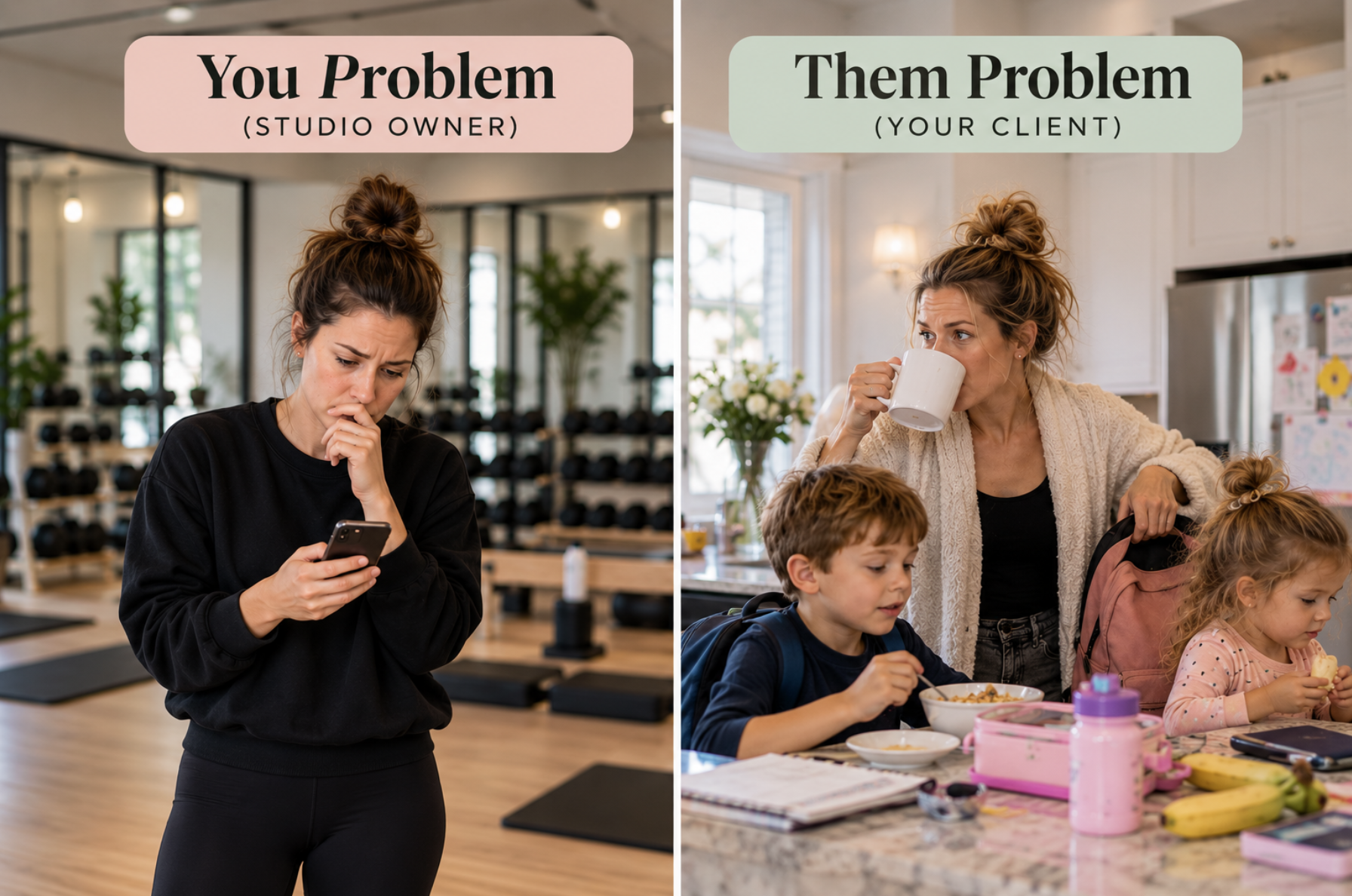
Studio owners are naturally amazing at reading people. You can spot a nervous first-timer from the front desk. You know which member would love a high five and which one needs you to leave them alone before 7 a.m. Reading people is part of the job.
Then we sit down to write a newsletter and all of that goes out the window.
"Spots open in Thursday's 6 a.m.!" "Join our email list!" "Look what we're doing!"
I've written every one of those, and so has every studio owner I've ever worked with. I call this phenomenon "you problems vs. them problems," and once you see it, you'll find it everywhere.
What's the difference between a you problem and a them problem in marketing?
In a nutshell, a “you problem” is marketing built around what your studio wants, e.g., people to book classes, intros to purchase memberships, email addresses, etc. A “them problem” is marketing built around what your potential member already wants, needs, or is frustrated by. That's why they reached out in the first place.
The action doesn't change. You're still filling the 6 a.m. class, growing your list, or reaching out. You're just giving people a reason to care before you ask them to take action.
In my MBA marketing class, we learned about “inside-out vs. outside-in messaging.” Inside-out messaging starts with what the business wants to say about itself. Outside-in messaging starts with how the customer already talks about their problem. Messaging strategists note that inside-out copy tends to sound vague and a little self-congratulatory, while outside-in copy amplifies the customer's own thoughts and results they care about.
Copywriters have an even shorter version: WIIFM, or "What's in it for me?" It's the question every person scrolling past your post is silently asking. A you problem leaves them to figure out the answer. A them problem answers it in the first line.
Quick gut check: if you swapped your studio name for any other studio in town, would the message still work? If yes, you need to rework your messaging.

Why does customer-focused messaging get more studio members?
People skip marketing that's about you (they don't know you or care about you yet), but they pay attention to marketing that's about them. The research backs this up clearly.
People expect you to get them, and most brands don't. In one large study, 73% of customers said they expect companies to understand their needs and expectations, but only 51% said companies generally do.
They assume brand messages are self-serving. In another study, 70% of consumers said they believe brands share only out of a self-centered desire to make money, and 66% called their relationships with brands one-sided.
Leading with the need moves the needle. One ecommerce A/B test simply reordered the sales page copy so the customer's biggest need came first. Everything else was the same, but conversions went up 15.2%.
What does a them problem sound like in fitness studio marketing?
The easiest way to describe it is to name what your future member is dealing with before you ask for anything in return. Here are the ones I see most often, rewritten so the ask stays the same.
Filling an early class. Instead of "We have spots open in our 6 a.m. class," try "Can't seem to fit a workout in once the kids are up? Come get it done before everyone else wakes up."
Growing your email list. Instead of "Sign up for our email list!" try "Enter your email below to save $10 on your intro offer."
Checking in on a lapsed member. Instead of "I just wanted to reach out and check in," try "Haven't seen you since the holidays! Is everything okay? Can I save you a spot in class this week?"
Booking reminders. Instead of "Don't forget to book your classes!" try "Tuesday's 12:15 class fills fast. Grab your lunch-break spot now so the week can't steal it."
Intro offers. Instead of "Come try a class!" try "Nervous about walking into a new studio? Your first class includes a 5-minute walkthrough, so you never feel like you don’t know what's going on."
Membership promos. Instead of "We're running a membership sale," try "If your gym membership has turned into a monthly donation, this is your easiest restart all year."
Start where your member already is before you ask for anything in return.

How do you audit your studio's messaging?
Homework: pull four recent pieces of marketing: your last newsletter, your last few Instagram captions, your homepage headline, and your intro offer description. Find every ask, then read the sentence right before it. Is it about your studio or your member? Count the "I"s and "we"s against the "you"s. If you're winning that count, your member won’t recognize themselves in your messaging.
The ask is fine- book, join, sign up, reply, come in: you need those. The problem is the sentence leading up to them. If it's about your schedule, your class, your sale, or anything else about you, you've found a you problem.
To fix it, ask who that class or offer is really for and what's getting in their way right now. Usually it's time, confidence, energy, or the awkwardness of coming back after a break. Rewrite only the lead-in and keep the ask. Borrow the exact words your members use, and your Google reviews are gold for this.
Last, run the swap test. If another studio in town could post it word for word, get more specific.
Meet your author

Hi, I'm Niki, a business coach that specializes in boutique fitness studios. I've spent over a decade in the industry and now I help you fix the stuff that's quietly costing you money: your intro offers, your pricing, your sales conversations, using actual buyer psychology instead of whatever everyone else in the industry is copying from each other.
I've got a Master's in Small Business and I've spent years helping studio owners like you build their dream businesses. If you want that kind of strategy in your corner, join the waitlist and I'll reach out personally when a spot opens up.